“When, if at all, can a federal political order expel a member state against its will?” This is my response to Can federations expel member states? On the political theory of expulsion by Eva Marlene Hausteiner. I agree that the absence of legal frameworks for expulsion/secession carries potential risks for any given federal system. It... Continue Reading →
The EU as a Patchwork of Models
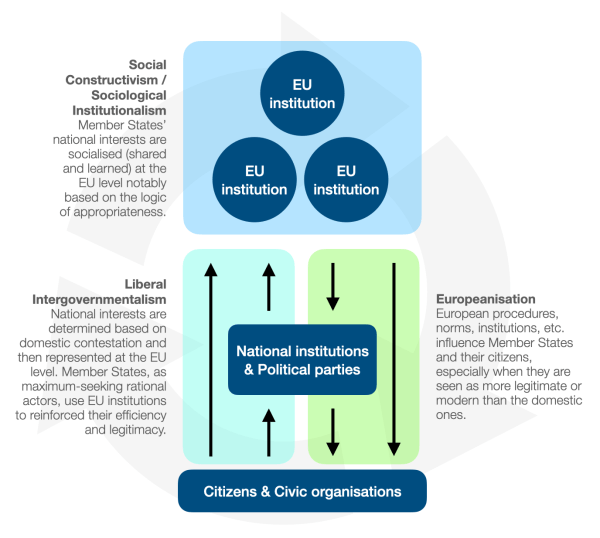
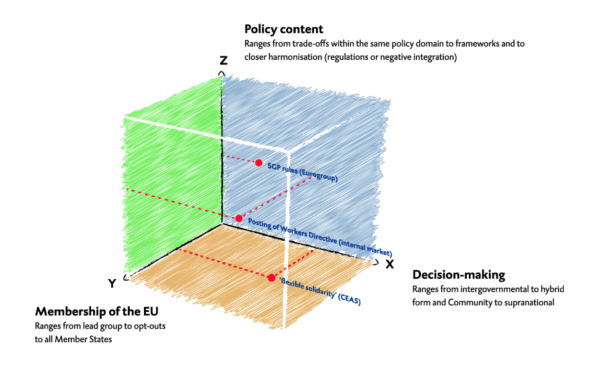
Various European integration models attempt to explain how each Member State’s national interests are represented at the EU level. The EU is foremost an international organisation that has been established as a result of intergovernmental agreements. Naturally, each member state (MS) is a key actor in the scene; each MS’s interests influence what decisions are... Continue Reading →
The EU as a Mixture of Supranationalism and Intergovernmentalism
The EU is a mixture of supranationalism and intergovernmentalism. The Future of Europe White Paper aptly states, "the EU is a unique project in which domestic priorities have been combined and sovereignty voluntarily pooled to better serve national and collective interests." In this regard, Levy (2015) makes an interesting comparison between the EU and the... Continue Reading →
How the European Union’s Green Recovery Plan can Make a Stronger Europe in the Post COVID World
IntroductionWith COVID-19, the year 2020 is inherently different from any other year this generation has seen. The pandemic’s impacts are so severe that many say the challenge is comparable to that of the Second World War. In this unprecedented trial, how will the European Union emerge? This essay argues that Europe has a chance with... Continue Reading →
Role of the European Court of Human Rights within the legal order of the EU
EU fundamental rights bind EU institutions (in all their acts) and Member States (while implementing EU law). Now, the problem with the European Convention on Human Rights (ECHR) is that (1) the ECHR and the EU are two separate entities; (2) the EU is yet to accede to the ECHR (despite the EU’s good intentions);... Continue Reading →
Different constellations in which Member States are bound by EU fundamental rights
The Member States are bound by EU fundamental rights when they are implementing EU law. The contention, however, has been regarding what constitutes the ‘implementation of EU law’. What follows is my digest of the list of cases from the CJEU’s Fact Sheet on Field of Application of the Charter of Fundamental Rights of the... Continue Reading →
The development of ECJ case law on the fundamental political status of Union citizenship
Discussion on the fundamental political status of Union citizenship demands a careful examination in two dimensions. The first dimension is the role of EU citizenship as a legal status, particularly within the framework of the intergovernmental agreement reached by the Member States but endowed with supranational institutions—including the ECJ—which operate autonomously. This dimension has a... Continue Reading →
National Constitutional Courts’ varying claims to review possible infringements by EU law
Hoffmeister (2007) categorises 27 EU MS into five theoretical models in regards to their procedures of ratifying EU treaties. The first group of countries apply their constitutional provisions as regards the ratification of international treaties irrespective of the unique nature of the European Union. The second group of countries (limitation of sovereignty) recognise that sovereignty... Continue Reading →
Can the European Migration and Asylum Policy be Reformed?
The right to asylum is explicitly stated in the EU Treaties. Article 18 of the Charter of Fundamental Rights of the European Union states, “the right to asylum shall be guaranteed”. This ethos is repeated in Articles 67(2) and 78 of the Treaty on the Functioning of the European Union (TFEU). It is against EU... Continue Reading →
Cohesion Policy Trends in Lisbon Strategy and Europe 2020
The Lisbon Strategy, also known as the Lisbon Agenda or Lisbon Process, was an action and development plan devised in 2000, for the economy of the European Union between 2000 and 2010. Europe 2020, on the other hand, is a 10-year strategy proposed by the European Commission on 3 March 2010 for the advancement of... Continue Reading →